
Share Gerald R. Ford's obituary with others.
Invite friends and family to read the obituary and add memories.
Stay updated
We'll notify you when service details or new memories are added.
You're now following this obituary
We'll email you when there are updates.
Select your format and elements to print

IN LOVING MEMORY OF Gerald R. Ford
Gerald R.
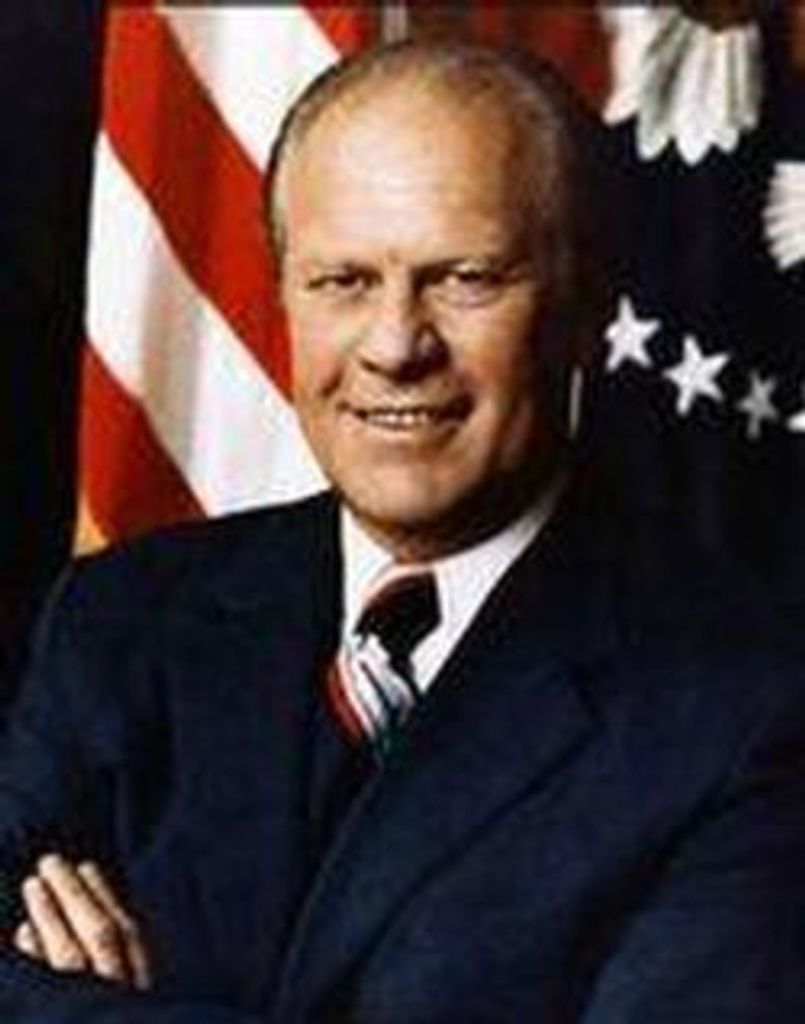
Ford
Jul 14, 1913 — Dec 27, 2006
Gerald R. Ford's Obituary
By J.Y. Smith and Lou Cannon Special to The Washington Post Wednesday, December 27, 2006; A01
Gerald Rudolph Ford Jr., 93, who became the 38th president of the United States as a result of some of the most extraordinary events in U.S. history and sought to restore the nation's confidence in the basic institutions of government, has died. His wife, Betty, reported the death in a statement last night.
"My family joins me in sharing the difficult news that Gerald Ford, our beloved husband, father, grandfather and great grandfather has passed away at 93 years of age," Betty Ford said in a brief statement issued from her husband's office in Rancho Mirage, Calif. "His life was filled with love of God, his family and his country."
The statement did not say where Ford died or give a cause of death. Ford had battled pneumonia in January and underwent two heart treatments -- including an angioplasty -- in August at the Mayo Clinic in Rochester, Minn.
"With his quiet integrity, common sense, and kind instincts, President Ford helped heal our land and restore public confidence in the Presidency," President Bush said last night in a statement. Bush was notified of Ford's death shortly before 11 p.m., the White House said.
Ford was the longest-living president, followed by Ronald Reagan, who also died at 93. Ford had been living at his desert home in Rancho Mirage, about 130 miles east of Los Angeles.
Ford was the only occupant of the White House never elected either to the presidency or the vice presidency. A former Republican congressman from Grand Rapids, Mich., he always claimed that his highest ambition was to be speaker of the House of Representatives. He had declined opportunities to run for the Senate and for governor of Michigan.
He was sworn in as president Aug. 9, 1974, when Richard M. Nixon resigned as a result of the Watergate scandal.
"My fellow Americans, our long national nightmare is over," Ford said in his inaugural address.
"I believe that truth is the glue that holds government together, not only our government, but civilization itself. That bond, though strained, is unbroken at home and abroad."
Ford had become vice president Dec. 6, 1973, two months after Spiro T. Agnew pleaded no contest to a tax evasion charge and resigned from the nation's second-highest office. The former Maryland governor was under investigation for accepting bribes and kickbacks.
In the 2 1/2 years of his presidency, Ford ended the U.S. involvement in the war in Vietnam, helped mediate a cease-fire agreement between Israel and Egypt, signed the Helsinki human rights convention with the Soviet Union and traveled to Vladivostok in the Soviet Far East to sign an arms limitation agreement with Leonid Brezhnev, the Soviet president.
Ford also sent the Marines to free the crew of the Mayaguez, a U.S. merchant vessel that was captured by Cambodian communists.
On the domestic front, he faced some of the most difficult economic conditions since the Great Depression, with the inflation rate approaching 12 percent. Chronic energy shortages and price increases produced long lines and angry citizens at gas pumps. In the field of civil rights, the sense of optimism that had characterized the 1960s had been replaced by an increasing sense of alienation, particularly in inner cities. The new president also faced a political landscape in which Democrats held large majorities in both the House and the Senate.
But Ford's overriding priority was ending the constitutional and political crisis known as Watergate. It had begun June 17, 1972, when five operatives of Nixon's reelection campaign were caught breaking into Democratic National Committee headquarters in the Watergate office building.
The White House denied any involvement. But as the situation unfolded, the central question was whether Nixon had tried to obstruct the subsequent investigation. A special prosecutor sought answers on tapes Nixon had made of his Oval Office conversations.
The president resisted turning them over on the ground that this would violate executive privilege, but in July 1974, a unanimous Supreme Court ruled against him. Within days, prosecutors found a tape on which Nixon apparently ordered a coverup. The House judiciary committee approved three articles of impeachment. Faced with the virtual certainty of a trial by the
Gerald R. Ford's Guestbook
Visits: 3
This site is protected by reCAPTCHA and the
Google Privacy Policy and Terms of Service apply.
Service map data © OpenStreetMap contributors