
Share Bishop Paul J. Swain's obituary with others.
Invite friends and family to read the obituary and add memories.
Stay updated
We'll notify you when service details or new memories are added.
You're now following this obituary
We'll email you when there are updates.
Select your format and elements to print

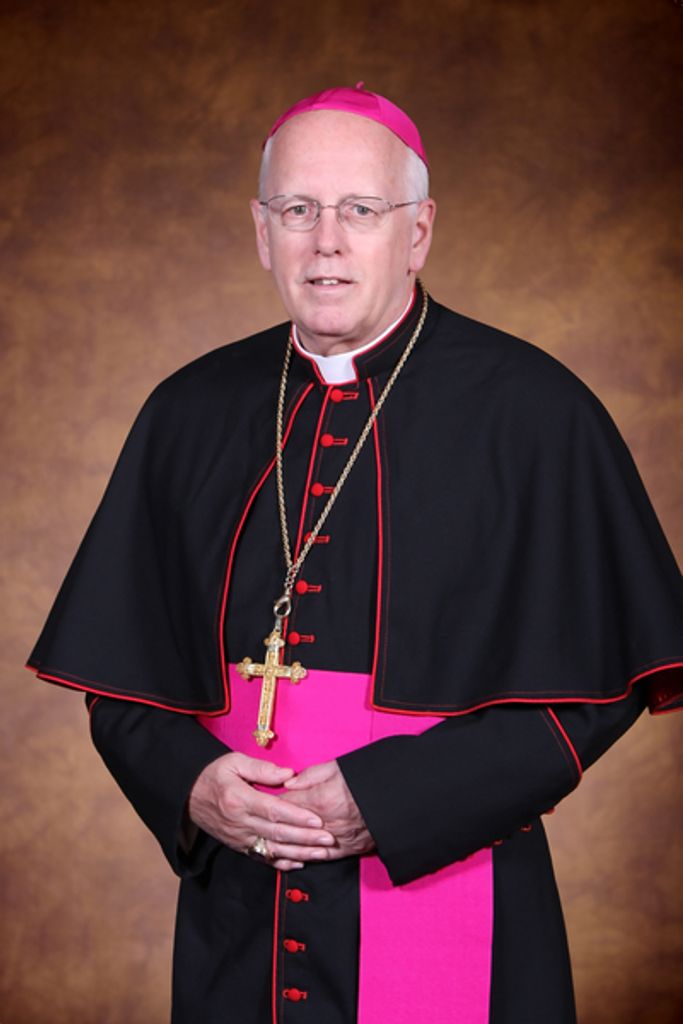
IN LOVING MEMORY OF Bishop Paul J. Swain
Bishop Paul
J. Swain
d. Nov 26, 2022
Bishop Paul J. Swain's Obituary
Most Reverend Paul J. Swain
The Most Reverend Paul J. Swain passed to eternal life on November 26, 2022 while in hospice care at Dougherty House, nearly 15 years to the day since he had blessed Avera's beautiful, new facility as Bishop of Sioux Falls. He was 79 years old.
A Mass of Christian Burial will be celebrated on Saturday, December 3 in the Cathedral of St. Joseph beginning at 10:00 am. The Most Reverend Bernard Hebda, Archbishop of St. Paul & Minneapolis will preside at the Mass.
Recitation of the Rosary will begin at 6:00 pm Friday, December 2, followed by a liturgical wake service will be prayed on in the Cathedral beginning at 6:30 pm. The wake will be preceded by a visitation beginning at 1:00 pm in the Cathedral church.
Both Liturgical Wake Service and Mass of Christian Burial will be livestreamed on the church YouTube channel. To view click this link; https://www.youtube.com/@SFDiocese
Paul Joseph Swain was born on September 12, 1943 in Newark, NY. He was the son of William E. and Gertrude (née Shawcross) Swain. Paul was the 5 th of 6 children. He and his siblings were raised by their grandparents.
As a child, Paul received his religious formation in the Methodist church. He would attend Sunday school classes and Sunday services with his grandparents. In high school, he first aspired to be an attorney and took an interest in the political process. He graduated from Newark High School in 1961.
The prompting of a neighbor whose son was a professor at the school led to his enrollment at Ohio Northern University in Ada, OH where he studied history. He moved to Madison, WI in 1965 and enrolled at the University of Wisconsin-Madison to pursue a master's degree in political science.
Upon completing his master's degree, Paul voluntarily entered military service as an intelligence officer in the United States Air Force. This service included time served in Vietnam during the Vietnam War and earned him the distinction of a Silver Star commendation. Paul once shared to a Chamber of Commerce Veteran's Day Service audience that "(he) left the military after nearly five years. But the experiences shared, not all of which I can or want to talk about, remain with me to this day." He emphasized that "(t)he casualties of war are not only the physically dead. They are those who remain anguished by the experience, and those who despite their scars have learned to cope. We remember them as well and must insist that they receive the medical and other assistance they need, earned and are owed."
With his military service completed, Paul returned to Madison where he enrolled in the University of Wisconsin's law school. In 1974 he was awarded his Juris Doctorate and he began a private practice in law. He would often say that the hardest part of being an attorney was timekeeping as "6-minute increments were hard to keep track of."
In 1978, Paul became involved with the unconventional and underfunded gubernatorial campaign of a newcomer to the political scene and chancellor at the University of Wisconsin-Stevens Point, Mr. Lee S. Dreyfus. Paul's involvement became noticed by Mr. Dreyfus, so much so that upon his election, Governor Dreyfus asked Paul to serve as Legal Counsel to the Governor and Director of Policy.
Nearing the end of his first term and despite popularity among voters, Governor Dreyfus announced that he would not seek a second term. This caused Paul to immediately contemplate his own next professional role. For Paul, the thought of becoming a priest entered his mind and heart in ways such that it would not leave. This of course was rather curious since he was not yet a Catholic.
After receiving instruction on the Catholic faith, the Easter Vigil in 1983 was when Paul was confirmed and received his first Holy Communion at Holy Redeemer Church in Madison. Later that summer, he would enroll at Pope St. John XIII Seminary in Weston, MA as a seminarian for the Diocese of Madison.
On May 27, 1988, Paul was ordained a priest for the Diocese of Madison by the Most Reverend Cletus O'Donnell in the Cathedral of St. Raphael.
Father Paul Swain held many appointments for the Diocese of Madison, including vocations director, moderator of the curia, priest secretary, and vicar general, a role he would hold for two different bishops. His pastoral work included stints at Sacred Hearts of Jesus & Mary in Sun Prairie, St. Mary in Pine Bluff, St. Bernard in Middleton, St. Patrick and Holy Redeemer in Madison, and as rector of St. Raphael Cathedral. In June of 1998, Father Swain was elevated to Monsignor when the Holy Father, Pope John Paul II appointed him as a prelate of honor.
On August 31, 2006, Pope Benedict XVI appointed him as Bishop of Sioux Falls. He was ordained and installed as the 8 th Bishop of the Diocese by Archbishop Harry Flynn on October 26, 2006, an office he would serve in until being succeeded on February 13, 2020. The 13 years that Bishop Swain served as spiritual shepherd for Catholics in eastern South Dakota are marked by many highlights, cultural & social changes, and measured responses to changes.
During his time in office, Bishop Swain ordained 33 men to the priesthood and 20 men to the permanent diaconate. He was exceptionally pleased to have each one of these men accompany him as ordained brothers in service of Christ's Church.
Bishop Swain led the diocese in a restoration of our Cathedral of St. Joseph, elevating this civic and sacred landmark by bringing forth its beauty as envisioned by the original architect. Addressing Mass congregants on the day he dedicated the new altar that was installed, Bishop Swain shared that "(i)t is my prayer that this restored Cathedral will be a shining light on the hill outside and in, by the beauty of sacred things and by the beauty of faith lived well, can therefore be a sign of the hope that can only be fulfilled in Christ. And so we invite all to come here on pilgrimage and to seek to satisfy the yearning for the holy, to discover meaning in the midst of trial, even fear, and to experience the peace that comes from knowing Jesus Christ as Lord, Savior and friend."
A noteworthy part of the restoration was that it led to a church that was well-equipped to host the televised Sunday Mass, a liturgy that became a priority for Bishop Swain. As a result, the TV Mass became an important way by which Bishop Swain sought to connect with the faithful of our diocese personally through both liturgy and our mother church.
Responding to a dire need of the city of Sioux Falls, Bishop Swain oversaw the creation of the Bishop Dudley Hospitality House, an emergency shelter for individuals and families. At its blessing and opening, Bishop Swain described the new facility as "more than a shelter, it will be a Beacon of Hope, a house of hospitality that welcomes, that treats each person with respect, that seeks to help address special needs, that offers a helping hand, that says you matter and that sees Christ in each person with wisdom of the heart, that calls each person by name."
As Bishop, he blessed 8 different properties in 6 communities that were erected by St. Joseph Catholic Housing to provide affordable housing for families. Similarly, 7 different facilities built by Avera to expand its healthcare outreach were also blessed by Bishop. He spent time praying the rosary in front of Planned Parenthood every month that he served as Bishop, save for the time when he suffered a medical event. Joining Bishop Robert Gruss of Rapid City, he created the South Dakota Catholic Conference as a ministry to assist Catholics in their efforts to apply Church teaching in their daily lives.
Bishop Swain led an effort to erect a permanent home for the Adoration Sisters of the Blessed Sacrament who pray continuously for the needs of the diocese. At the invitation of Senator Thune also served as chaplain to the United States Senate for a day and led 8 different pilgrimages to holy sites across the globe.
Facing a decline in the number of available priests and the withdrawal of religious orders who were serving our diocese, Bishop Swain oversaw a consultative planning process that involved over 6 years of listening sessions and facilitated meetings. In most of those churches that no longer saw regular Sunday liturgies as a result of the planning process and recognizing the grief that existed, Bishop Swain presided at Masses of Thanksgiving.
Similarly, Bishop Swain shared often how one of the most spiritually-moving moments of his ministry as bishop happened when he accompanied the Benedictine Monks at Blue Cloud Abbey through a discernment process that led to the community's dissolution.
Always a student of history and an advocate for understanding the lessons it offers us, Bishop Swain directed that the legacy of ministry we inherit as Catholics living in eastern South Dakota was to be commemorated as part of our celebration of the 125 th anniversary of the Diocese's creation. The legacy events showed over time that they fostered a renewal in the Diocesan Church.
Bishop Swain was very proud of his investiture as a Knight in the Equestrian Order of the Holy Sepulcher of Jerusalem as with his appointment as a Fourth Degree Knight of Columbus.
While addressing the clergy of the Diocese a mere 8 months after his installation, Bishop Swain humbly projected that he was likely to "frustrate (them)." He did so knowing himself well. Insisting on being able to explain a decision was an essential element to his leadership style. And, despite attempts to apply pressure on him for the sake of expedience or convenience or simply for the sake of closure, Bishop Swain was steadfast in this self-discipline, seeking to know the full context of any decision and to "think through" the ramifications of any decision before it was made. Those who knew him on a deeply personal level also knew well that he frustrated no one more than himself as he yearned to know clearly God's will before making major decisions he faced.
Nearing the point of his mandatory retirement, having grown fond of and cared for so many of the faithful that he had encountered since his arrival in 2006, Bishop Swain proudly declared himself a "South Dakotan" and announced his intention to remain here in his retirement.
His episcopal motto, confitemini Domini , "give praise to the Lord," was Bishop Swain's way of expressing his lived belief that it is not what we do but how we conduct ourselves that matters most in the Christian life.
Bishop Swain was preceded in death by his parents and his five siblings and three of their spouses. He is survived by one sister-in-law.
In lieu of flowers, memorials can be directed to the Cathedral of St. Joseph maintenance endowment at the Catholic Community Foundation for Eastern South Dakota, the Adoration Sisters, or the Bishop Dudley Hospitality House.
Funeral Services for Bishop Paul J. Swain
Funeral Mass

Saturday
The Cathedral of St. Joseph
Starts at 10:00 am
Bishop Paul J. Swain's Guestbook
Visits: 18
This site is protected by reCAPTCHA and the
Google Privacy Policy and Terms of Service apply.
Service map data © OpenStreetMap contributors